What should a savings circle organiser write down before the first contribution?
Almost everything that goes wrong in a savings circle goes wrong for the same reason: something was assumed at the start and remembered differently in round five.
Nobody is being dishonest. People simply carry different pictures of the same conversation. "I thought we said the seventh." "I thought late meant a week, not three days." The circles that run for years, whether you call them paluwagan, ajo, esusu, chama, dhukuti or pardner, tend to have one habit in common: they settle the important questions before any money moves, and they write the answers down where everyone can see them.
It does not need to be a formal document. It needs to be a page. Here are the seven lines that belong on it.
1. The amount, and the day
How much each member puts in, and how often: £100 on the last Friday of the month, £25 every Friday, whatever suits your group. Add the day it is due, and the way it is paid: cash, bank transfer, standing order. Set the amount at what the least comfortable member can manage every single round, not at what the most comfortable member suggests.
2. Who is in, and how many
The full list of names, and the number they add up to. That number sets the pot (members × contribution) and the length of the cycle (members × interval), so it is worth choosing deliberately. Smaller, shorter circles are easier to run and easier to trust, which is why many organisers keep a first circle to somewhere between four and eight people. We looked at how to choose in how many people should be in your savings circle.
3. The order, and how it was decided
The list of turns, first to last, and the method that produced it: a draw, an agreed rotation, need first, seniority. The method matters less than the timing. An order agreed at the start is structure; an order argued about in round four is a dispute. Add the swap rule while you are there: any two members may trade places by mutual consent, the group is told, and the record changes the same day. There is more on the methods in how to decide the order in a savings circle.
4. What counts as late, and what happens then
Three days? A week? Who covers a short round, and how do they get repaid? Rules written when nothing is at stake and nobody is being accused of anything are simply administration. The same rules written mid-argument sound like an accusation. Also write down the difference between stopping before your turn, when the circle owes the member, and stopping after it, when the member owes the circle. Those are different conversations. What happens if someone stops paying walks through both.
5. What happens if someone wants to leave
People move, change jobs and hit hard months. Write the exit before anyone needs it. The usual answers, roughly in order of how often circles reach for them, are these: someone takes the seat, the member steps back and is settled when the cycle closes, or the circle finishes the cycle short by agreement. The first question is always which way the money points: has this member been paid yet, or not? See when a member wants to leave your savings circle.
6. Whether places can be shared or doubled
Two sisters sharing one place, or a trusted member taking two, are old and legitimate arrangements. The rule that keeps them clean is simple: every seat has exactly one name of record, and any sharing happens outside the circle's book. Say whether your circle allows either, and on what terms. We cover it in can two people share one place in a savings circle.
7. Who runs it, and who decides what the page doesn't cover
Every circle has an organiser, and every organiser eventually meets a situation the page does not cover. Write down how those get decided: the organiser alone, the organiser with two members, or the whole group. The best answer is whichever one your members will still accept when the decision goes against them.
Then, the part people skip
Read it aloud at the first meeting, or send it to the group, and ask everyone to say "agreed" in their own words. A rule that has been agreed publicly is far harder to misremember than one that was merely understood.
Then put it somewhere permanent. Not in one person's notebook, and not in a group chat that will scroll past it by Tuesday. The page only works if every member can find it again in month eight.
Where Roscas comes in
Roscas is a free app for running the circle you already have. It does not ask you to change how your circle works, and it does not introduce a new set of rules. It records the ones you just wrote down: the members, the amount and the day, the order of turns, who has paid this round and whose turn is next, all visible to every member, so nobody has to ask.

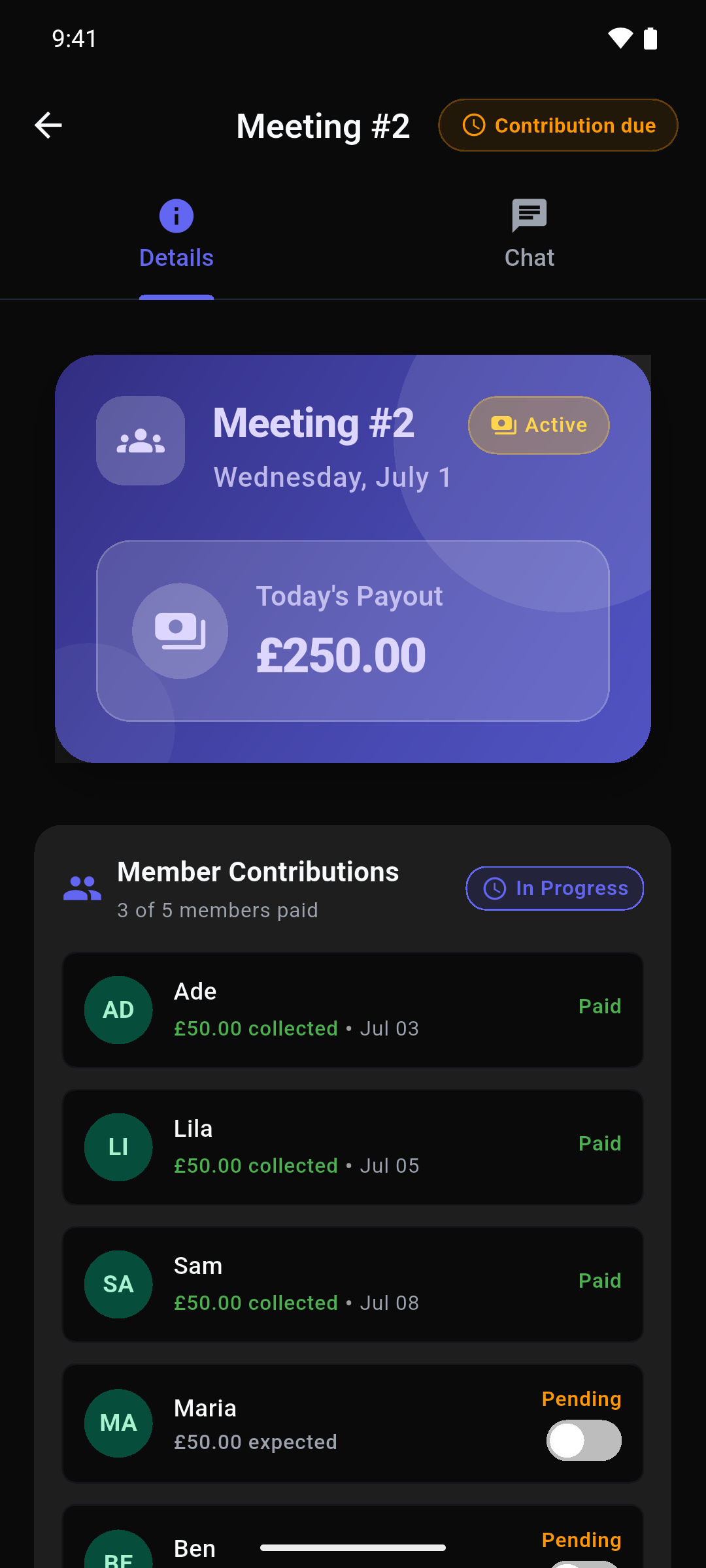
A few things worth saying plainly:
Roscas never touches the money. Contributions and payouts move exactly as your circle moves them today. Nobody connects a bank account to join.
Roscas is free, permanently. No fee per circle, no charge per member, no paid tier waiting further up.
Roscas doesn't rate your members or sell anything to your circle. It keeps the record. What your circle makes of it is your business.
Roscas is in beta on Android, and we are inviting organisers to bring the circle they already run, rules and all.
Keep your circle. Lose the spreadsheet. Get started at roscas.io/your-circle