What happens if someone in your savings circle stops paying?
It is the question that stops circles before they start.
Someone floats the idea — a paluwagan with people at work, an ajo among cousins, a chama with the school-run mums, a pardner hand, a dhukuti with families from home — and within two minutes somebody asks it. But what if someone doesn't pay?
It deserves a straight answer rather than a reassuring one. Here is the straight answer, and what circles that have run for years actually do about it.
First: what "stops paying" usually means
Almost never what people picture.
The overwhelming majority of missed contributions are late, not gone. A pay date moved. A bank switched and the standing order didn't follow. A hard month nobody saw coming — a boiler, a funeral, a cut in hours. Occasionally a member who has quietly decided the amount is too much for them and hasn't found the words to say so.
Deliberate dishonesty exists, but it is rare, and it is not what makes circles fail. What makes circles fail is far more ordinary: embarrassment looks exactly like dishonesty from the outside. Both produce silence. Someone who has gone quiet is usually more worried about it than you are — and the longer the silence runs, the harder it becomes for them to break it.
Most of what follows is really about shortening that silence.
The distinction that decides everything: before or after their payout
This is the single most useful thing an organiser can understand, and it is rarely spelled out.
If someone stops paying before their turn comes, the circle has a short round to solve. Nobody has lost money yet. The member has put money in and taken nothing out, so they are owed something back if they leave — what the group has to decide is how to cover this round's pot and how to settle up fairly.
If someone stops paying after they have received their payout, this is different in kind, not degree. They have taken the pot and stopped contributing towards everyone else's. The loss doesn't fall on the circle in the abstract — it falls squarely on the members whose turn hasn't come yet.
Nearly every sensible rule a circle makes is really about narrowing that second case.
What experienced circles do
None of this needs an app. It needs deciding in advance.
Agree the rules before you need them. What counts as late — three days, a week? What happens then? Who covers a short round, and how is it paid back? What happens if someone genuinely needs to leave mid-cycle? A rule agreed at the start, when nothing is at stake and nobody is being accused of anything, is administration. The identical rule invented in round six is a dispute.
Put the order where the risk isn't. Across a lot of traditions, newer members are placed later in the rotation, and the organiser often takes the first or last hand. That is not suspicion — it's structure. A member who receives in round nine has contributed eight times before they take anything, and their reliability is a known quantity by then rather than a hope.
Keep it a group, not a list. People pay people they know. A circle that has grown past the point where everyone knows everyone has quietly become something else.
Talk early, privately, and once. The most effective thing any organiser does is a quiet one-to-one message in round two — is everything alright? do you want to talk about the amount? — rather than a pointed message in the group chat in round six. Early and private gives someone a way back in. Late and public gives them a reason to disappear.
Write down what gets agreed. If a member falls behind and you agree they'll make it up over two rounds, that agreement needs to sit in the record where the whole group can see it. Agreed and written down, it's a plan. Agreed in a WhatsApp message you'll never find again, it's a rumour, and in four months two people will remember it differently.
Let people leave well. A member who says "I can't carry on, can you find someone to take my place" has not defaulted — they've done the responsible thing. Make that an easy, unembarrassing option and you convert a potential loss into an admin task. Many circles keep a reserve member in mind for exactly this.
Three things that don't work
The group-chat callout. Shame reliably produces withdrawal, not payment.
The organiser quietly covering the gap. Extremely common, entirely well-meant, and corrosive. It hides the problem from the people who need to know about it, puts your own money at risk, and makes the circle dependent on your savings rather than on its own rules.
Waiting to see if it sorts itself out. It occasionally does. The rest of the time you have simply arrived at the same conversation later, with more money involved.
Where Roscas comes in
Roscas is a free app for running the circle you already have — and it is worth being plain about what it does and doesn't do here.
It will not make anyone pay. No app can. Anything that claims to be able to is really placing a middleman between your group and its money, and that is not what we are. Roscas never touches the money. Contributions move exactly as they do now — bank transfer, standing order, cash in hand — and nothing comes out of the pot, ever.
What it does is close the gap between something going wrong and everyone knowing about it.
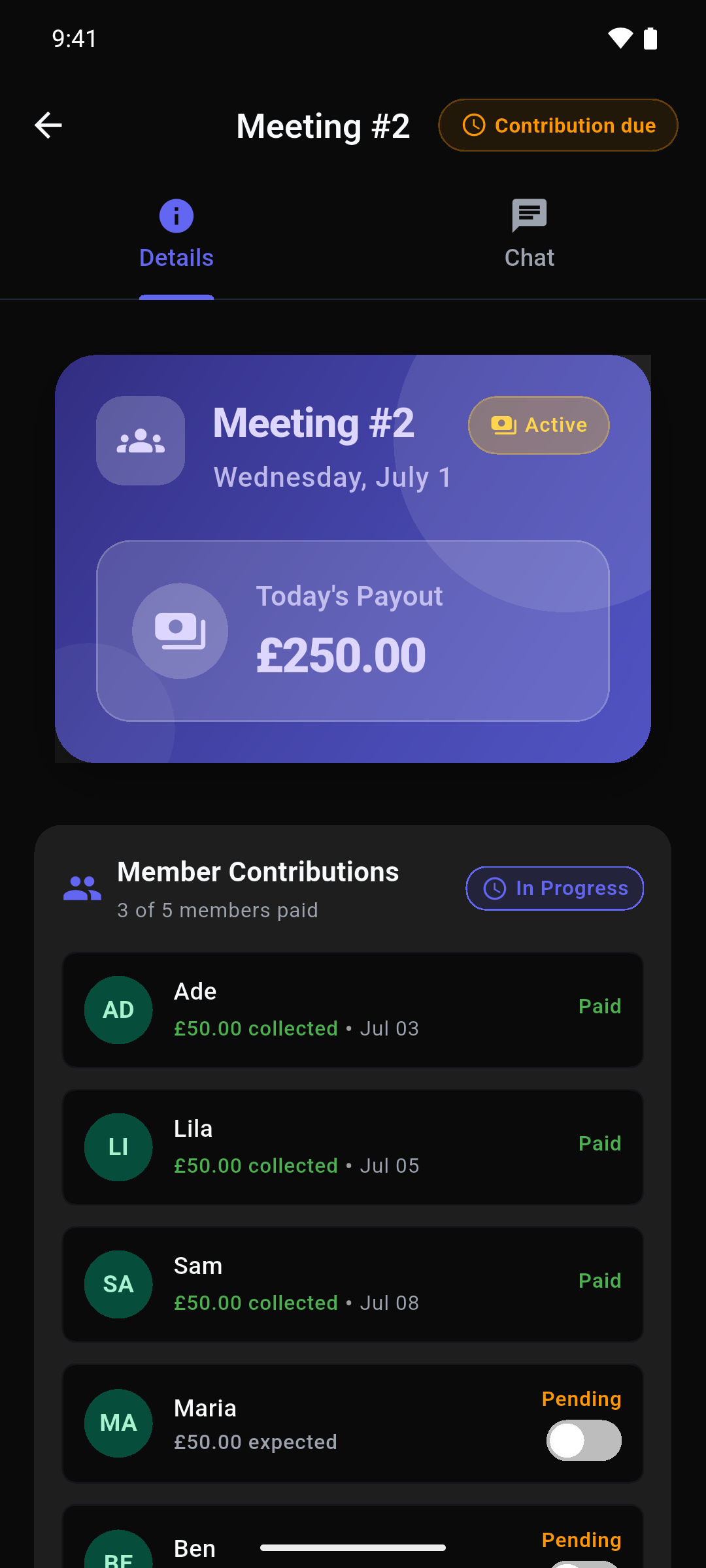
The record is live and shared, so a missed contribution shows up in round two instead of surfacing in round six. Reminders go to everybody on the same day, every round, so nobody is singled out and chasing stops being something you do to your friends. And because the record belongs to the group rather than to one person's laptop, a difficult conversation is about a shared picture, not about your word against theirs.
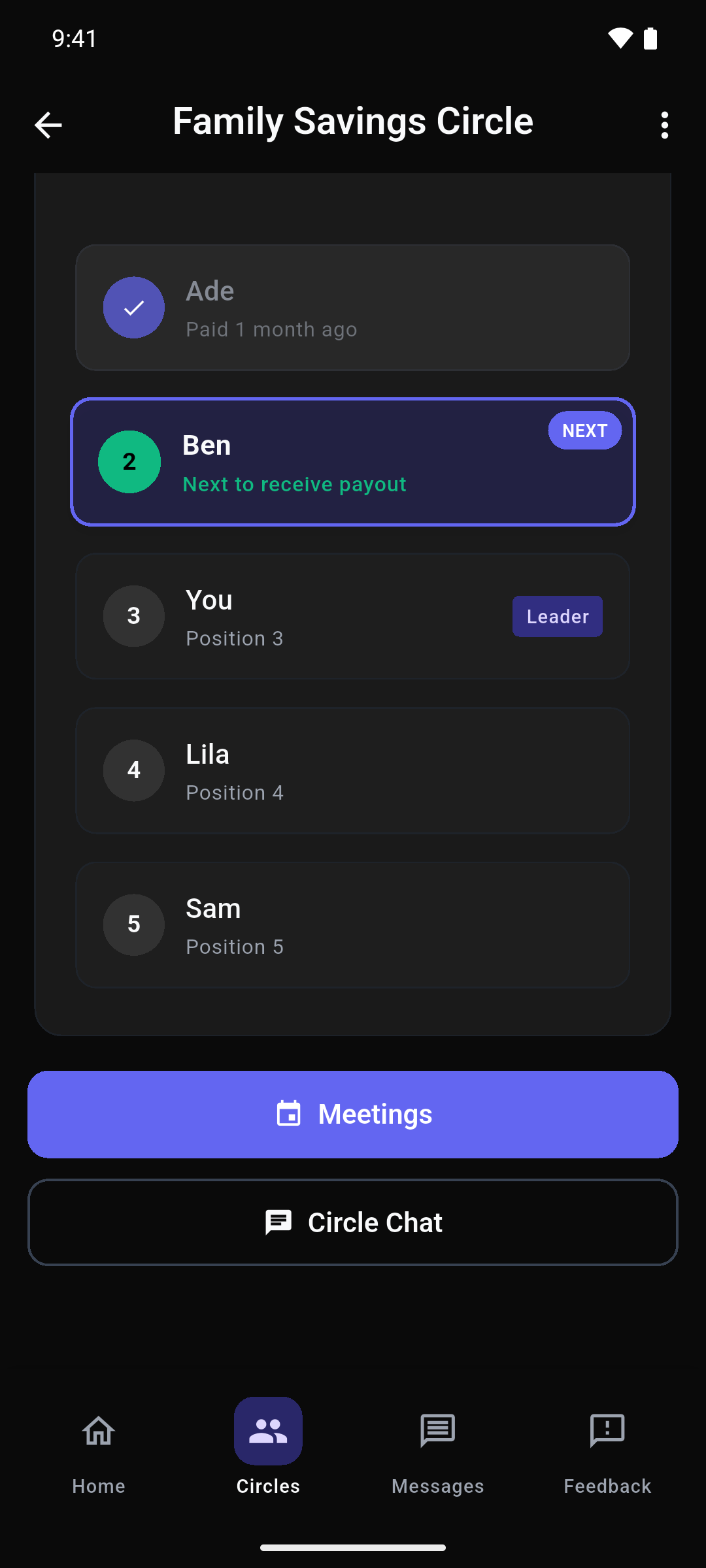
Free means free: no fees, no cut of anyone's payout, no paid tier appearing a few rounds in. Permanently.
Roscas is currently in beta on Android, and we're inviting organisers to bring the circle they already run — the members you have, the amount you agreed, the order your group decided. Nothing about how you do things has to change.
Keep your circle. Lose the spreadsheet. Get started at roscas.io/your-circle