What does a savings circle organiser do when a member wants to leave?
Sooner or later, someone asks. A job moves them to another city. Money gets tight. A relationship ends, or a parent falls ill. And they come to you — usually apologetically, often by message rather than in person — and ask whether they can come out of the circle.
Whether you run a paluwagan, an ajo or esusu, a chama, a dhukuti or a pardner hand, this is the question with no obvious answer, because a savings circle is not an account anyone can close. There is no pot sitting somewhere with your member's name on it. Their money has already gone to whoever's turn it was.
That is exactly what makes the exit feel awkward. It is also what makes it solvable — once you ask one question first.
The question that decides everything: which way does the money point?
Before you offer anyone anything, work out whether the member leaving is owed by the circle or owes the circle.
They have not had their turn yet. They have paid in round after round and received nothing back. The circle owes them. Their leaving is an administrative problem — a real one, but a problem with answers.
They have already had their payout. They took the pot, and their remaining contributions are what pay the members still waiting. They owe the circle. That is not an exit at all; it is a member stopping paying, which is a different conversation with a different answer — and the loss falls on people who have not been paid yet, not on the person leaving.
Everything below is about the first case. It has clean answers, and most organisers only know one of them.
Four ways out, roughly in the order circles try them
1. Someone takes their seat. The most common answer and usually the best. A circle is a set of slots, not a set of names: slot four contributes on the same day and draws in the same month whoever is sitting in it. If the leaver brings a replacement, the replacement takes their position in the rotation, and the two of them settle privately for what has already been paid in. The circle's own arithmetic never changes — which is why this route causes the least disruption to everyone else.
Two cautions. The replacement has to be someone the whole group is comfortable with, not only the person leaving — that judgement is yours, and you are allowed to say no. And the settlement between them should be a number you have written down for both, not a figure they argue about later.
2. They stop contributing and are settled when the cycle closes. If no replacement can be found, the member steps back and the circle repays what they put in at the end of the cycle. It works, but say the trade-off out loud: the pot is smaller for every remaining round unless the others cover the gap, and the leaver waits months for money they need now. Some take it anyway, because it is certain.
3. The circle closes the cycle early — deliberately. If only two or three turns remain, the group can agree to finish the cycle short and not renew. Everyone still waiting gets paid, at a smaller pot or a shorter interval, and the circle ends on a decision rather than a drift. Heavy at round three; the cleanest answer there is at round nine.
4. The organiser pays them out of their own pocket. Named because it is the first instinct of almost every good organiser, and the one to be most careful with. It settles the matter in an afternoon — and it hides what happened from the group, sets a precedent you cannot repeat, and turns a circle problem into a private loan nobody else knows about. If you do it, tell the group you did.
Do the arithmetic in the open
Whichever route you take, put two numbers in front of the leaver and, if it affects them, the group:
- What they have paid in to date.
- What they were due to receive, and when.
Write both down before you propose anything. Most exit disputes are not really about fairness — they are about two people holding different figures in their heads and each assuming the other is being difficult.
Handle the conversation before you handle the mechanics
Ask why, privately, once — not to talk them out of it, but because some reasons are things in the circle you can fix and most are not.
Then tell the group. Not the reason, which is theirs, but the fact and the plan: Ana is stepping out, Marisol takes her place from October, the order is unchanged. A member who simply disappears costs far more trust than one who leaves properly, because everyone left behind quietly wonders what they were not told.
Agree it before anyone needs it
The best time to answer this question is at formation, when it is hypothetical and nobody is upset. One line in whatever your circle uses as its book:
If someone needs to leave, they may find a replacement the group agrees to and settle with them privately. If they cannot, they stop contributing and are repaid what they have put in when the cycle closes.
Answered in advance, it is a short conversation. Invented in the middle of an emotional one, it is where fallings-out come from.
Where Roscas comes in
Roscas is a free app for running the circle you already have — including on the days it changes shape.
It does not decide who may leave your circle, and it should not. What it removes is the thing that actually makes exits messy: nobody being sure of the numbers. Every member's contributions are recorded as they are made, so what they have paid in is a figure you read rather than reconstruct from a year of messages.
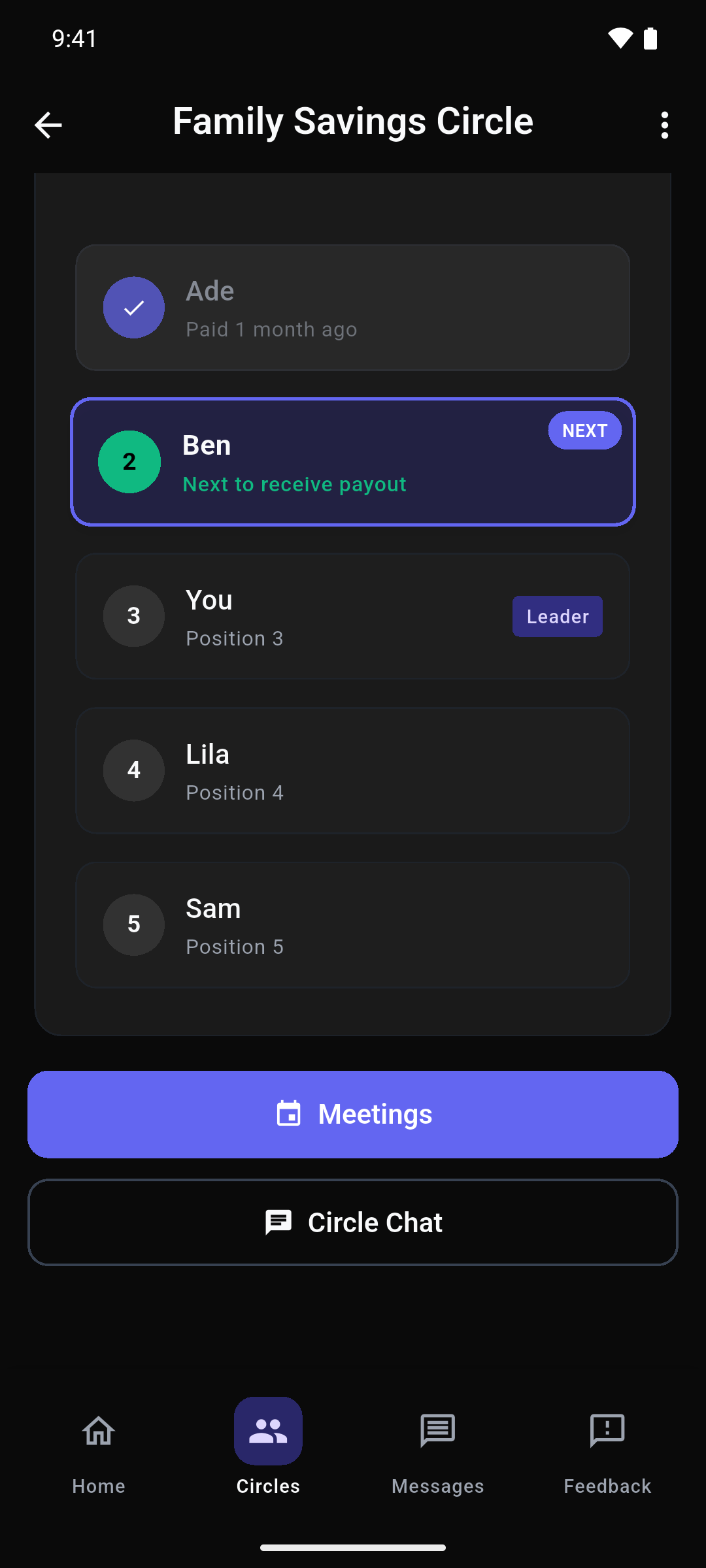
And because the full rotation is visible, a prospective replacement can see exactly what they would be taking on before saying yes — which position, which month, how many rounds left — instead of trusting a summary from someone who wants them to say yes.

Two things worth saying plainly. Roscas never touches the money — contributions and payouts move exactly as your circle moves them now, and nobody outside your circle takes a cut of a pot or asks anyone to sign anything to leave. And Roscas is free, permanently: free for your members and free for you, with no fee per circle and no subscription appearing once you have settled in.
Roscas is in beta on Android, and we are inviting organisers to bring the circle they already run — your members, your amount, your order, exactly as they stand.
Keep your circle. Lose the spreadsheet. Get started at roscas.io/your-circle