How do you decide the order in a savings circle?
Every savings circle has to answer one question before a single contribution is made: who gets the pot first?
It sounds small. It is the whole game. The order decides who is effectively borrowing and who is effectively saving, where the risk sits, and — handled badly — whether the circle survives its first disagreement. Communities running a paluwagan, an ajo or esusu, a chama, a dhukuti or a pardner hand have been answering it for generations, and between them they have settled on a handful of methods that work. Here they are, honestly compared — including the trade-offs each one carries.
First, understand what the order actually is
Take a ten-person circle paying £100 a month. The member who receives in month one collects £1,000 having paid in £100 — the group has, in effect, advanced them the rest, interest-free. The member who receives in month ten has paid £900 before they see anything — they are saving, pure and simple, with the group as their discipline.
Neither position is bad. Early turns suit someone with a bill arriving; late turns suit someone saving towards a date. But the two positions are not the same, and pretending they are is where arguments start. A good ordering method isn't the one that makes the maths equal — nothing can — it's the one everyone accepted before they knew which slot they'd get, or accepted knowing exactly which slot they'd get. Both work. The muddle in between doesn't.
The main methods
The draw. Names in a hat, or numbered slips, at the first meeting — many paluwagan groups run exactly this way, and plenty of chamas settle their merry-go-round order the same way. Its strength is that nobody chose, so nobody can be accused of favouritism; the order is fate, agreed in advance. Its weakness is the same thing: fate doesn't know that Amara has school fees due in September. Many circles soften this with one rule — after the draw, any two members may swap slots by mutual agreement, told to the whole group.
The agreed rotation. The group talks it through and builds the order around real life: the wedding in June, the tenancy deposit in October, the stock a member needs to buy before the busy season. Common across ajo and esusu groups, and the natural method for circles built from family or close friends. Its strength is that the order does useful work. Its cost is a harder first conversation — someone chairs it, usually the organiser, and it only ends well when everyone hears why each person is where they are.
Seniority and standing. In long-running circles, members who have completed previous cycles often take earlier turns than newcomers. This is sometimes read from outside as unfair. It is the opposite — it is the circle pricing trust honestly. A newer member who receives in round nine has shown up eight times before the group carries any risk on them; by their second cycle, they're the trusted one. (This is the same logic behind the organiser taking the first or the last turn — a custom found across many traditions, and covered properly in what happens if someone stops paying.)
Need first, declared openly. Some circles simply ask: who needs it soonest? A funeral, a visa fee, a rent rise — the group decides together and the order follows. This is the most communal method and the most demanding, because it relies on honesty in both directions: naming your need, and accepting someone else's is greater.
The bid or tender. In some traditions — certain dhukuti circles among them — members who want an early turn offer something for it, and the offer is weighed by the group. It rewards patience and puts a price on urgency. If your circle uses this form, the same rule applies as everywhere else: the group's method, agreed and understood by all, is the right one. Roscas doesn't run auctions for you — but the order your circle decides, however it decides it, is the order the app keeps.
Whatever you choose, three rules hold
Decide before money moves. The method matters less than the moment. An order agreed at the start — any order, by any method — is structure. An order argued about in round four is a dispute. This is the ordering version of a principle that applies to every rule a circle makes.
Write it down where everyone can see it. The full list, first to last, visible to every member from day one. Not in the organiser's notebook. Not in a WhatsApp message from four months ago that two people now remember differently. The single most common ordering dispute is not about the method — it's about what was agreed.
Agree the swap rule too. Life moves; a good circle lets the order move with it. The clean version: any two members may trade slots by mutual consent, the group is told, and the record is updated the same day. Swaps agreed privately and remembered differently are how a fair order becomes a contested one.
Where Roscas comes in
Roscas is a free app for running the circle you already have — and the order is a good example of what it does and doesn't do.
It doesn't decide the order. Your circle does, by whichever method your tradition and your group trust — the draw, the negotiation, seniority, need, the tender. What the app does is keep that decision visible: the full rotation, whose turn is now, whose turn is next, the same for every member.
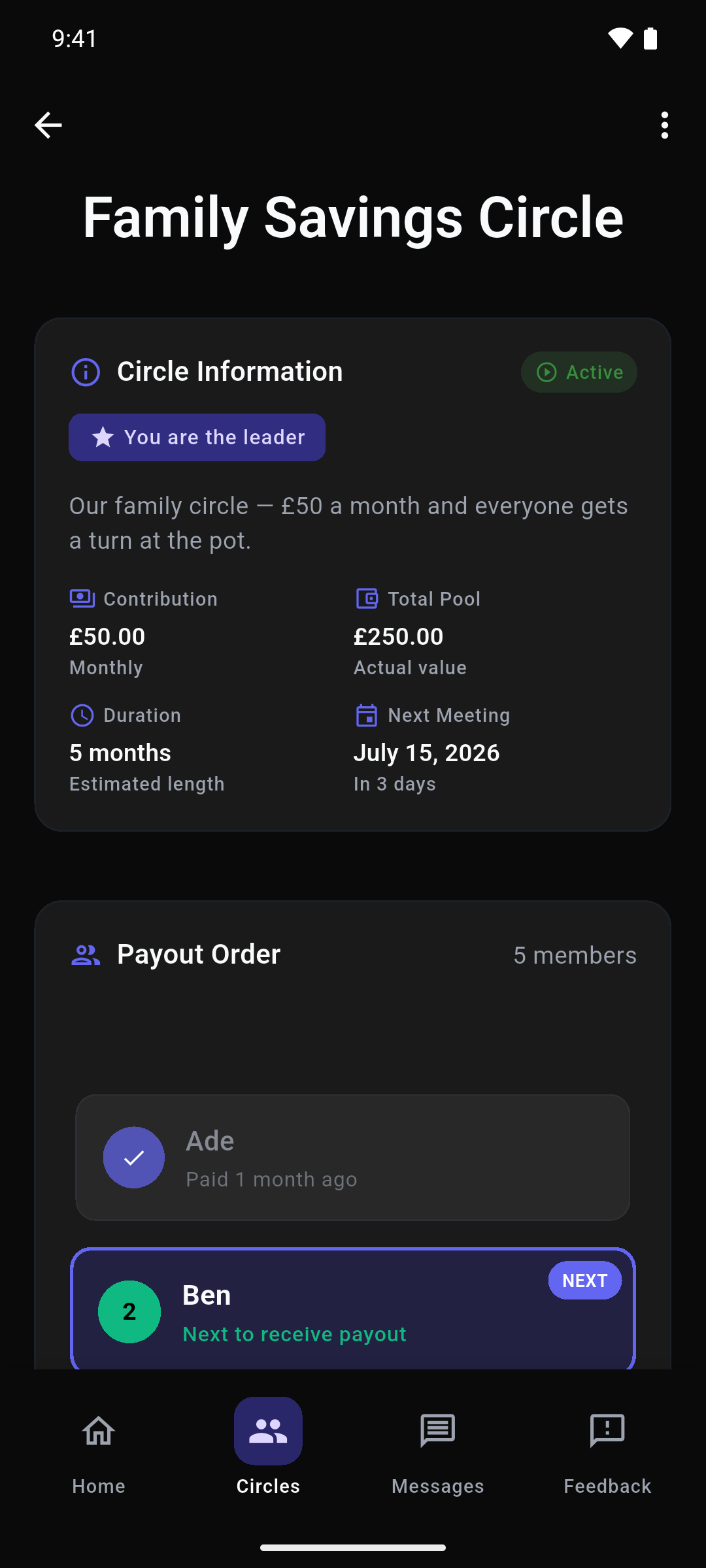
When a swap happens, it's changed once and everyone sees the same updated order — no version of the list on anyone's laptop quietly going stale. And when someone asks the question every organiser has answered forty times — when's my turn? — the answer is in their pocket, not in your evening.
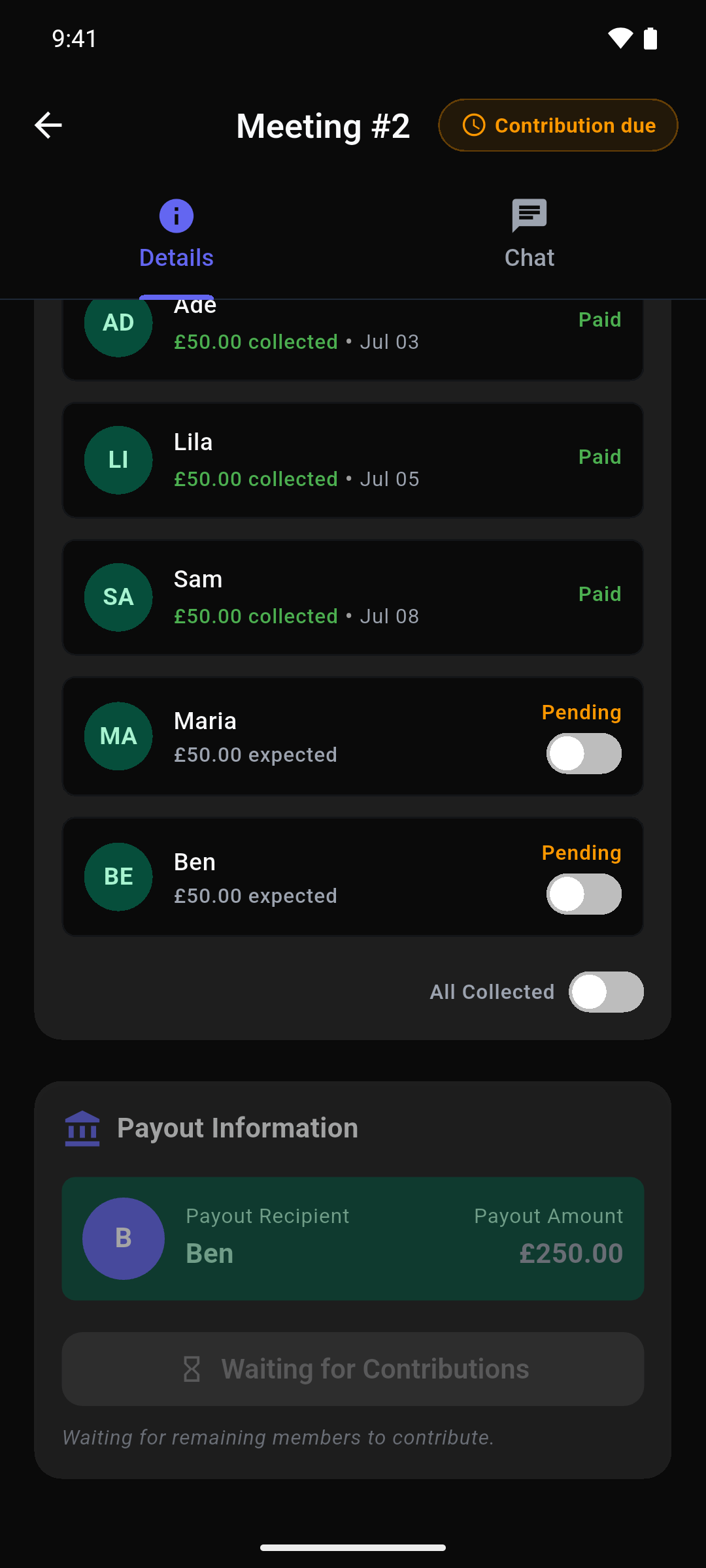
Roscas never touches the money. Contributions and payouts move exactly as your circle moves them now — bank transfer, standing order, cash in hand. And free means free: no fees, no cut of anyone's pot, no paid tier appearing later. Permanently.
Roscas is currently in beta on Android, and we're inviting organisers to bring the circle they already run — the members you have, the amount you agreed, and the order your group decided, in the order your group decided it.
Keep your circle. Lose the spreadsheet. Get started at roscas.io/your-circle