What's a ROSCA? The Community Savings Tradition Older Than Banks
You may not have heard the word "ROSCA" before, even if you've been part of one your whole life.
A ROSCA — short for Rotating Savings and Credit Association — is what economists call the thing your aunties have been doing for generations. It's the Paluwagan your colleague at the hospital quietly runs every payday. It's the Ajo your mother contributed to so she could fly home for a wedding. It's the Esusu that bought a small business its first delivery van. It's the Pardna that helped a family put down a deposit on their first flat.
Different communities. Different names. The same beautiful idea.
The shape of a ROSCA
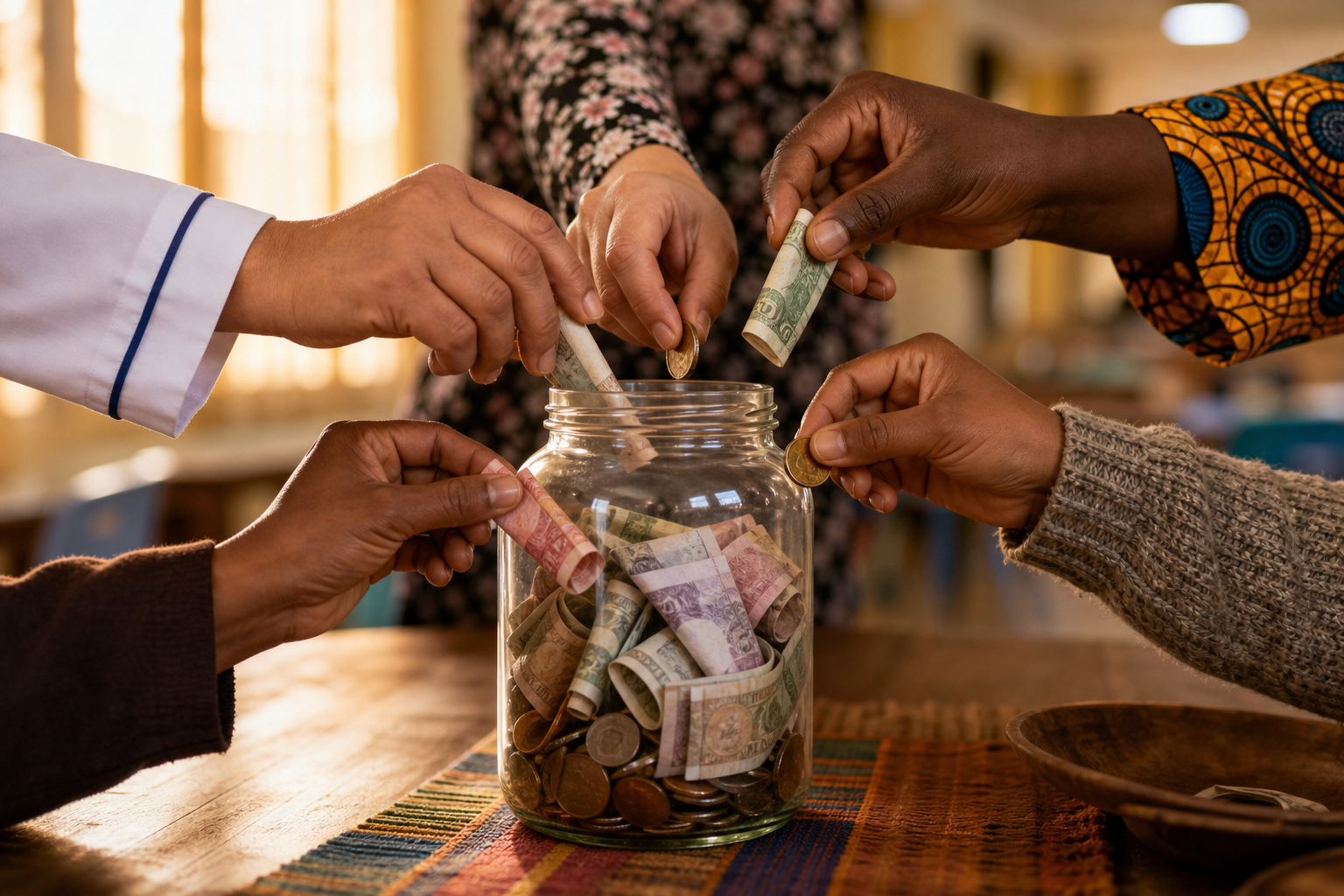
The core of it is simple. A group of people who trust each other agree to put in a fixed amount of money on a regular schedule — say £100 every month. Each round, one person takes home the full pot. After everyone has had their turn, the cycle ends. Then, if the group wants to, it starts again.
If ten people each put in £100 a month, every month one of them walks away with £1,000. By the time the cycle is over, everyone has put in £1,000 and taken out £1,000. Nobody is richer in arithmetic. But every member has had access — once — to a lump sum that would have taken them ten months to save on their own.
That lump sum is the magic of it. It pays for the deposit, the school fees, the flight home, the wedding, the new bed for the spare room. Things that wouldn't happen if you were drip-feeding pounds into a savings account on your own.
Names you might recognise
This idea is older than most countries on a modern map, and it lives in dozens of cultures under dozens of names. A few you'll hear in UK communities:
- Paluwagan — Filipino. Especially active among NHS nurses, church groups, and overseas Filipino workers.
- Ajo and Esusu — Nigerian (Yoruba and Igbo respectively). Often run through church communities, professional networks, and trade associations.
- Pardna — Jamaican / wider Caribbean. Deeply rooted in British Caribbean communities going back generations.
- Chama — Kenyan. Found in East African diaspora groups across the UK.
- Daret — Algerian / North African. Common among family and neighbourhood circles.
There are many more. Susu in Ghana. Tanda in Mexico. Hui in Chinese communities. Kye in Korean ones. The names change. The bones of the thing don't.
Why it works when it shouldn't
On paper, a ROSCA is a bit of a paradox. You're handing money to people on the strength of a promise. No collateral. No credit check. No legal contract in most cases. Just the word of the group.
It works because the group is the point. The people in a ROSCA are not strangers. They are your sister-in-law. The woman who sits next to you at church. The colleague you've worked alongside for eight years. The friend who watched your kids when yours were sick.
Trust isn't a feature you bolt on. It's the foundation the whole thing is built on. The social cost of not paying into your circle — of letting your aunt or your uncle or your work friend down — is far higher than any legal penalty would be.
That's why ROSCAs have outlasted empires. They run on something deeper than money.
The job of the organiser
Most circles have one person who holds the centre. The organiser. Sometimes called the banker, the head, the leader, the chairperson — every community has its own word.
The organiser keeps track of who has paid, whose turn it is next, and who needs a gentle nudge. They hold the WhatsApp group together. They vouch for new members. When something goes wrong — a missed payment, someone leaving mid-cycle, a member who needs an emergency swap with another — the organiser is the one who untangles it.
It is real work. It is often unpaid. It is almost always undervalued.
And in most circles today, that work is still being done with notebooks, spreadsheets, screenshots of bank transfers, and very long WhatsApp threads.
Where we come in
Roscas is a free Android app built for organisers and members running circles in their own communities. We don't change how a circle works. We don't replace the trust. We just take away the spreadsheet.
The app handles the running tally — who has paid, who hasn't, whose turn is next, what the pot looks like this round. Every member sees the same information, in real time. The organiser is freed from the admin. The community keeps the relationships.
We're built around the traditions that already exist. Paluwagan, Ajo, Esusu, Pardna, Chama, Daret — all welcome, all named in the app the way your community names them. We support fixed-rotation circles (the simple, classic format) and bid circles (where members can bid for an earlier turn). We never charge organisers or members anything. That is a promise, not a marketing line.
A small note on where we are
We're in early access. We are working with a small group of organisers running real circles in their own communities. If the things you've just read sound like the kind of group you already run, or already belong to, we'd love to hear from you.
Be part of it
- Already running a circle? Tell us about it at roscas.io/your-circle — we're looking for organisers to help shape the app.
- Just curious? Follow along on Facebook and Instagram — we share what we're learning as we build.
Whatever you call it in your community — keep doing what you're doing. We're just here to make the running of it a little easier.
More in this series: Running a Paluwagan? Keep Your Circle, Lose the Spreadsheet · Running an Ajo or Esusu? Keep Your Circle, Lose the Spreadsheet · Trust: The Currency Behind Every Savings Circle