Who's paid, whose turn, no chasing: what circle organisers actually spend time on
Ask someone who runs a savings circle what the job involves and you'll usually get a modest answer. Not much. You collect, you pay out, you keep a list.
Ask them on a Sunday night in the week a payment is late and you'll get a different answer.
The work of running a circle is real, and it is almost entirely invisible — including, quite often, to the organiser doing it. It doesn't show up as a task on a list. It shows up as a hundred small interruptions spread across a month, each one too minor to complain about and too frequent to ignore. This is an honest breakdown of what those interruptions are, and which of them you can hand back.
The five jobs, and why only one of them is the one people think of
Whether you run a paluwagan, an ajo or esusu, a chama, a pardner hand, a dhukuti or a circle that goes by a name only your family uses, the organiser's month splits into the same five jobs.
1. The ledger. Recording what came in. This is the job everyone pictures, and it's the smallest one — ten minutes a month if the payments arrive tidily.
2. The chase. Noticing that someone hasn't paid, deciding whether it's late enough to mention, working out how to mention it without embarrassing them, and then doing it again next round. This is the job nobody warns you about, and it's the one that costs the most — not in minutes but in weight. Chasing a friend for money is a genuinely uncomfortable thing to do repeatedly.
3. The answer desk. Did my transfer land? Whose turn is it after Ade? How many rounds have I got left? Every one of these questions has an answer sitting in your file, and every one of them requires you personally to go and look. Ten members asking one question a month is ten interruptions, and they never arrive when you're at your laptop.
4. The memory. The exceptions. Who paid two rounds ahead before going away. Who swapped turns with whom and whether the swap was for one round or permanently. Who is short by £20 from March and has agreed to make it up in August. Most of this lives in the organiser's head, not in any file, and that's exactly why the circle can't run without them.
5. The reassurance. The one that never gets counted. You are the reason ten people are comfortable putting money into a pot every month. That trust is the actual product, and holding it is a low-level, permanent responsibility.
Here's the thing worth sitting with: jobs 2, 3 and 4 all exist for one reason — the record is in one place and only one person can see it. They are not inherent to running a circle. They're a side effect of how the record is kept.
What actually reduces the load
You can cut most of that workload without changing a single rule of your circle, and without any software at all. Four things do the heavy lifting.
Make the record visible instead of available. "Ask me and I'll check" generates the answer desk. "Everyone can see it" ends it. This is the single highest-leverage change an organiser can make, and it's the one most circles never make, because the record started as a personal note and never stopped being one.
Separate the reminder from the relationship. A chase feels personal because it comes from you. A reminder that goes to everyone on the same day, every round, regardless of who has paid, isn't a chase — it's a rhythm. Members respond to it far better, and you stop being the person who asks friends for money.
Write down the exceptions the day they happen. Not at the end of the round. The swap you agree in a WhatsApp message on a Tuesday is the thing you'll be trying to recall in November. Exceptions kept in your head are the reason you can't go on holiday.
Agree what happens before it happens. Decide as a group — at the start, when nothing is at stake — what a late payment means, how a turn swap gets agreed, and what happens if someone needs to leave. A rule agreed in advance is administration. The same rule invented mid-crisis is a dispute.
Do those four things on paper and you'll feel the difference. The organiser's job shrinks back towards job 1 and job 5 — the small one and the important one.
Where Roscas comes in
Roscas is a free app that does exactly those first two things for you.
Your circle's record lives on everyone's phone instead of your laptop. Every member sees the same live picture: who has contributed this round, whose turn is next, and when the next collection is due. The answer desk closes, because nobody has to ask you — they can just look.
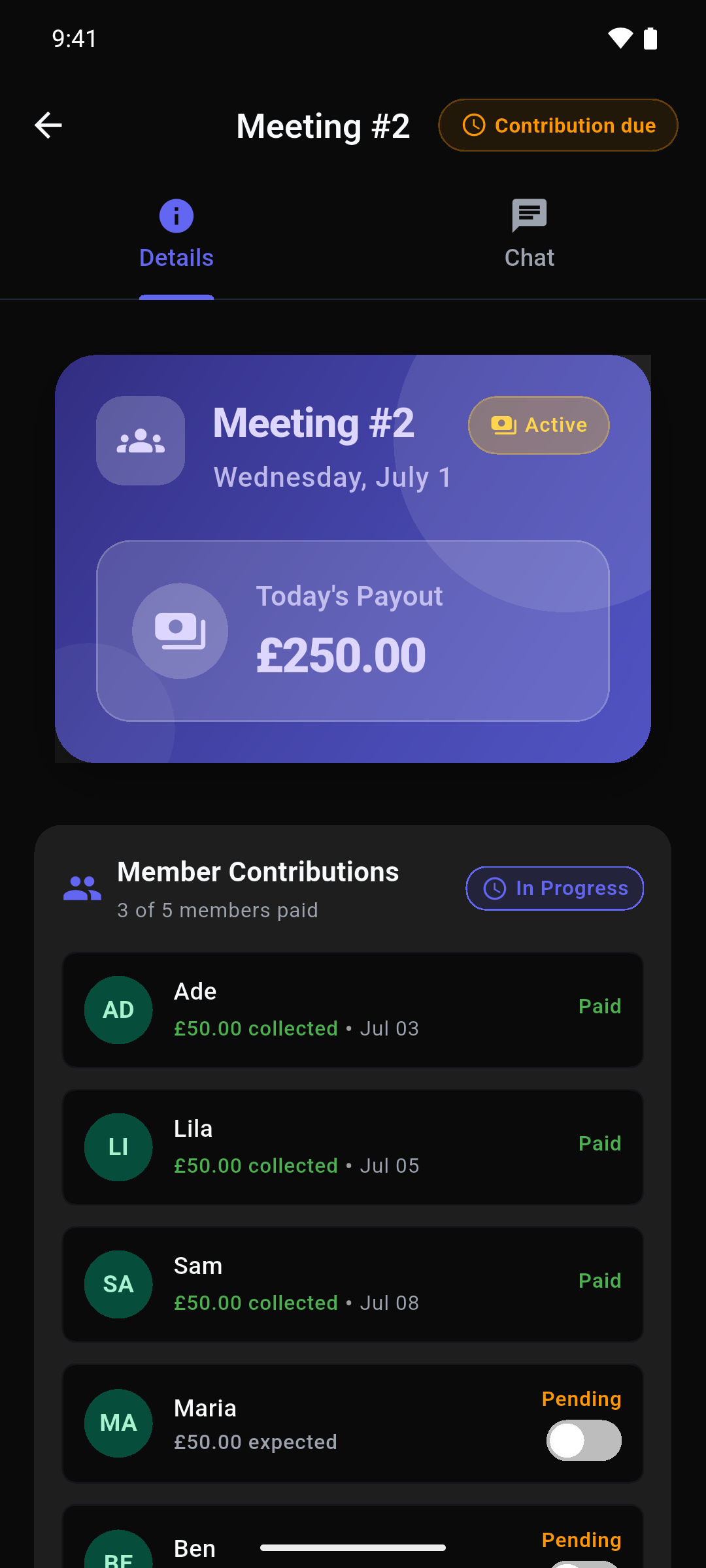
Reminders go out automatically on the schedule your circle already keeps, to everyone, on the same day. Chasing stops being something you do to your friends.

Two things worth being clear about. Roscas never touches the money. Contributions move exactly the way they move today — bank transfer, standing order, cash in hand — and nothing comes out of the pot. It's the record, not a middleman. And it's free: no fees, no cut of anyone's payout, no paid tier appearing a few rounds in. Permanently.
You set it up the way your circle already runs — your members, your amount, your rhythm, the turn order your group agreed. Nothing about the way you do things has to change.
Roscas is currently in beta on Android, and we're inviting organisers to bring the circle they already run. Not to start something new. Just to stop carrying the record on your own.
Keep your circle. Lose the spreadsheet. Get started at roscas.io/your-circle