Dhukuti, Digital
The word dhukuti began life as an object: a storage box, the place a household kept its grain and its valuables safe. Somewhere along the old trans-Himalayan trade routes, among the Thakali of Nepal's Thak Khola, the box became something bigger — a way for a group of trusted people to pool what they had, so that each in turn could reach for something none of them could manage alone. Centuries later it is still going strong, and it travelled a long way from the mountains. It runs today in Aldershot — the town Nepali families call Little Kathmandu — and in Reading, Farnborough, Swindon, Ashford, Folkestone and every corner of London where Gurkha families settled and where Nepali nurses and carers built new lives.
Wherever a dhukuti runs, the shape is familiar. Ten to twenty people who trust each other put in a fixed amount on a fixed rhythm, and each round one member takes the whole pot. And wherever it runs, one person keeps the record. If that person is you, this one is for you.
The organiser's evening
A dhukuti carries real weight. In Nepal it grew from a savings habit into an informal people's bank, funding shops, tools and small businesses that no ordinary lender would touch. That trust doesn't run itself — someone holds it together.
The organiser's real week looks like this. Logging each contribution as it lands. Matching the bank transfers and the remittance-app confirmations against the list. Remembering that Bishnu paid two rounds ahead before flying home to Pokhara, and that Anjali and Prakash swapped turns because of a deposit on a flat. Sending reminders — carefully worded, because these are your neighbours, your temple, your regiment's families. And answering, over and over, the question every organiser knows by heart: "Mero palo kahile?" — when's my turn?
None of that is the dhukuti. The dhukuti is the trust, the turn-taking, the quiet pride of a group that looks after its own. The rest is bookkeeping — and it usually lives in an exercise book, a spreadsheet, or a Viber group hundreds of messages deep.
Five habits of a dhukuti that lasts
Circles that run for years — and plenty do — tend to share the same habits, whether their records live on paper or on a phone.
1. Agree the terms before the first rupee — or pound — goes in. The amount, the rhythm, the number of members, what happens if someone misses a round or leaves mid-cycle. In a small rotation this is a single page. Settling it at the start is a conversation; settling it after a problem is a dispute.
2. Be clear about how turns are decided. Some dhukuti simply rotate in a fixed order agreed at the outset. Others use the older bidding form, where the pot goes by secret tender to whoever will take the largest discount that round — an elegant system, but one that only stays fair when every member can see the same figures. Whichever your circle uses, the rule must be visible and the same for everyone.
3. Collect on payday, not before it. A contribution due just after the end of the month arrives on its own. One due just before has to be chased. For members on NHS or care-sector rotas paid on the last working day, this single habit removes half the organiser's reminders.
4. Keep one record every member can check. Most dhukuti disagreements aren't about honesty — they're about two people remembering the same payment differently. It only feels fair when the record everyone relies on is one everyone can see.
5. Share the load. The circles that burn out their best organiser are the ones where the same person carries the book, year after year, because nobody else can face it. A record the whole group can see is the first step to sharing that weight.
Do these five and your dhukuti will outlast most — no app required.
The record is the weak point
Look back at that list: nearly every habit rests on the record. And the record usually rests on one person. The exercise book lives in the organiser's bag. The spreadsheet lives on their laptop. Members can't see either, so they message the organiser — who becomes the single point of failure in a group whose whole purpose is shared strength.
The tradition isn't the problem. The tracking is.
Where Roscas comes in
Roscas is a free app built for exactly this. It doesn't change how your dhukuti works — it takes the bookkeeping off the organiser's shoulders and puts it where the whole group can see it.
You set the circle up the way it already runs: your members, your contribution amount, your rhythm, the turn order your circle agreed at the start. From then on, everyone sees the same live record — who has contributed, whose turn is next, when the next collection falls due. Reminders go out automatically, so the chasing stops being one person's job.

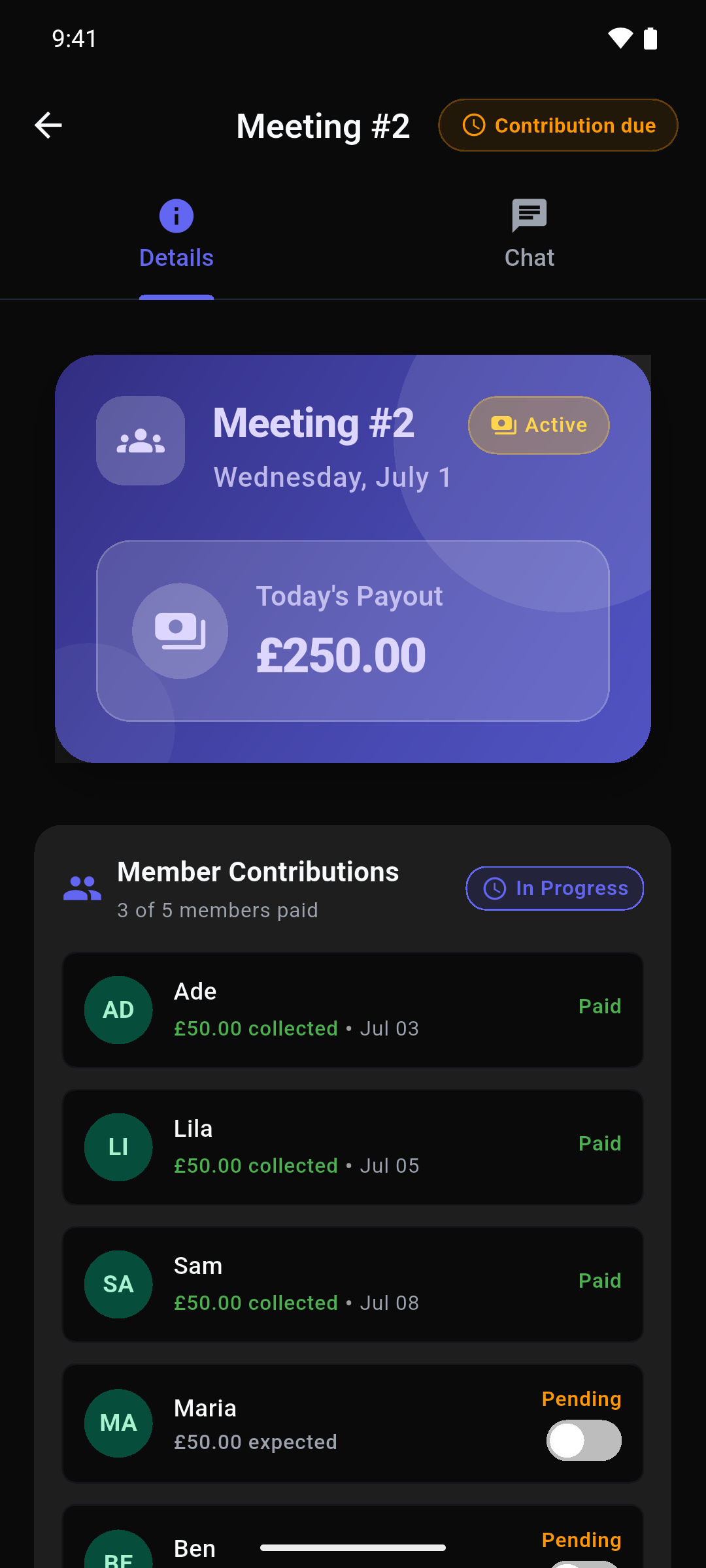
Two things worth knowing. First, Roscas never touches the money. Contributions move the way your circle already moves them — bank transfer, remittance app, cash in hand — and the app never takes a rupee or a penny from the pot. It is the shared record, not a middleman. Second, it is free — completely and permanently. No fees, no cut, no paid tier waiting around the corner.
Roscas is currently in beta on Android, and we're inviting organisers to bring the dhukuti they already run. You don't need to start something new or talk anyone into new rules. Same circle, same people, same trust — just with the exercise book retired.
Keep your circle. Lose the spreadsheet. Get started at roscas.io/your-circle